Orientación4 min de lecturaArtículo en inglés
Balcony solar on an east-facing or west-facing balcony: how much output can you expect?
Por ahora, esta guía solo está disponible en inglés.
En resumen
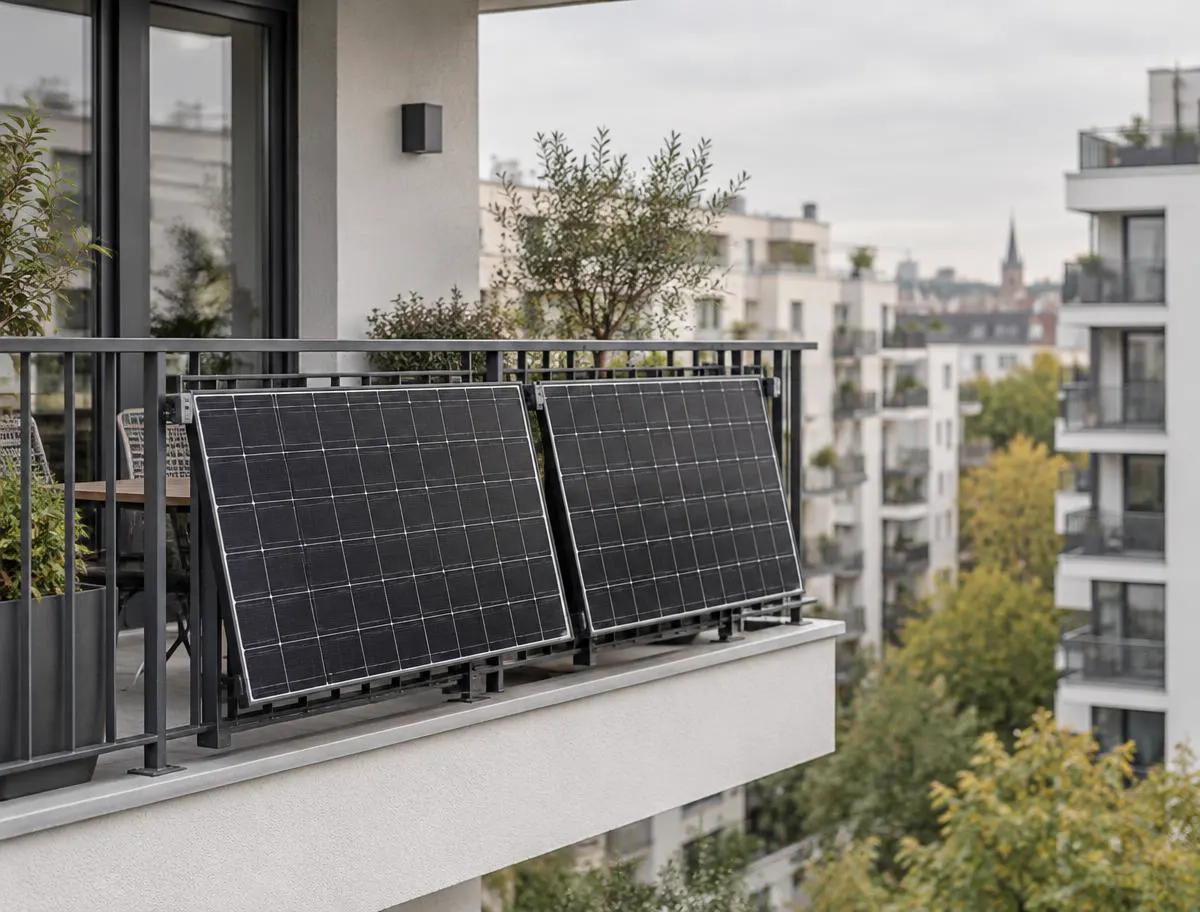
The good news: a balcony solar system is almost always worthwhile, even without a perfect south-facing balcony. A west-facing balcony generates around 75 to 80% of a south-facing system’s output, particularly when you are at home in the evening.
Why does orientation matter?
Solar panels generate the most electricity when sunlight strikes the panel surface perpendicularly. In Germany, the sun is in the south at midday, which is why a south-facing orientation is considered optimal.
With an east-facing or west-facing installation, the sun faces your panel directly in the morning or evening respectively. You get a smaller midday peak, but a flatter generation curve spread over a longer period.
Output comparison by orientation (800 W system, Berlin)
| Orientation | Annual output (kWh) | Share compared with south | Savings (~30 cents) |
|---|---|---|---|
| South (optimal, 30°) | ~750 kWh | 100% | ~€225/year |
| South-west (225°) | ~710 kWh | 95% | ~€213/year |
| West (270°) | ~580 kWh | 77% | ~€174/year |
| South-east (135°) | ~700 kWh | 93% | ~€210/year |
| East (90°) | ~560 kWh | 75% | ~€168/year |
| North (180°, rear side) | ~320 kWh | 43% | ~€96/year |
The underestimated advantage of east and west
West-facing balconies: perfect if you work away from home
A west-facing balcony generates most of its output between 13:00 and 19:00. This is exactly when many people come home from work, turn on the cooker or charge their laptops. It leads to significantly higher self-consumption than with south-facing systems, whose peak often falls during the lunch break.
| Scenario | Self-consumption, south | Self-consumption, west |
|---|---|---|
| Working away from home (out from 08:00 to 17:00) | ~25% | ~50 to 60% |
| Working from home | ~55% | ~50% |
East-facing balconies: the early-riser bonus
If you get up early, prepare breakfast and use a coffee machine, kettle and chargers, you benefit directly from east-facing generation. Output starts shortly after sunrise and ends around midday.
An east-west split: the optimal solution for many flats
If you have two balconies or a roof terrace facing two directions, you can orient one panel east and the other west. This has several advantages:
- A more even daily generation curve, without a strong midday peak.
- A longer daily generation period, from around 07:00 to 19:00.
- Higher self-consumption thanks to a more consistent supply.
- Lower peaks in inverter loading.
Annual output: east-west versus south (800 W system, Munich)
Panel tilt for east and west: flatter is better
For a south-facing installation, a tilt of 30 to 35° is optimal. For east-facing and west-facing installations, flatter angles of 15 to 25° are recommended because the sun is lower and a steeper panel would lose more output.
Many balcony mounting brackets are set to 25 to 35°. This is acceptable for east and west too, but a flatter setup delivers 3 to 5% more output.
How to calculate your exact output
A theoretical comparison is one thing. Actual results depend on your specific location, building, shading from neighbouring buildings and the seasons.
The BalkonSonne calculator uses satellite data and real-time solar irradiance values for your exact address.
Preguntas y respuestas
Las cifras de esta guía son ejemplos típicos para Alemania y dependen de la ubicación, la orientación, las sombras y el precio de la electricidad. Tu resultado puede ser distinto.
Comprueba tu ubicación en 2 minutos
Escaneo del cielo gratuito en el navegador del móvil. Sin descargas.
Iniciar el escaneo gratuito